Our Curriculum
At Hijrah Academy, our curriculum is not simply a collection of lessons. It is a carefully structured five-year journey designed to help children grow in Islamic knowledge, character, confidence and Muslim identity.
Pupils progress through clear developmental stages that build understanding gradually and appropriately for their age and maturity.
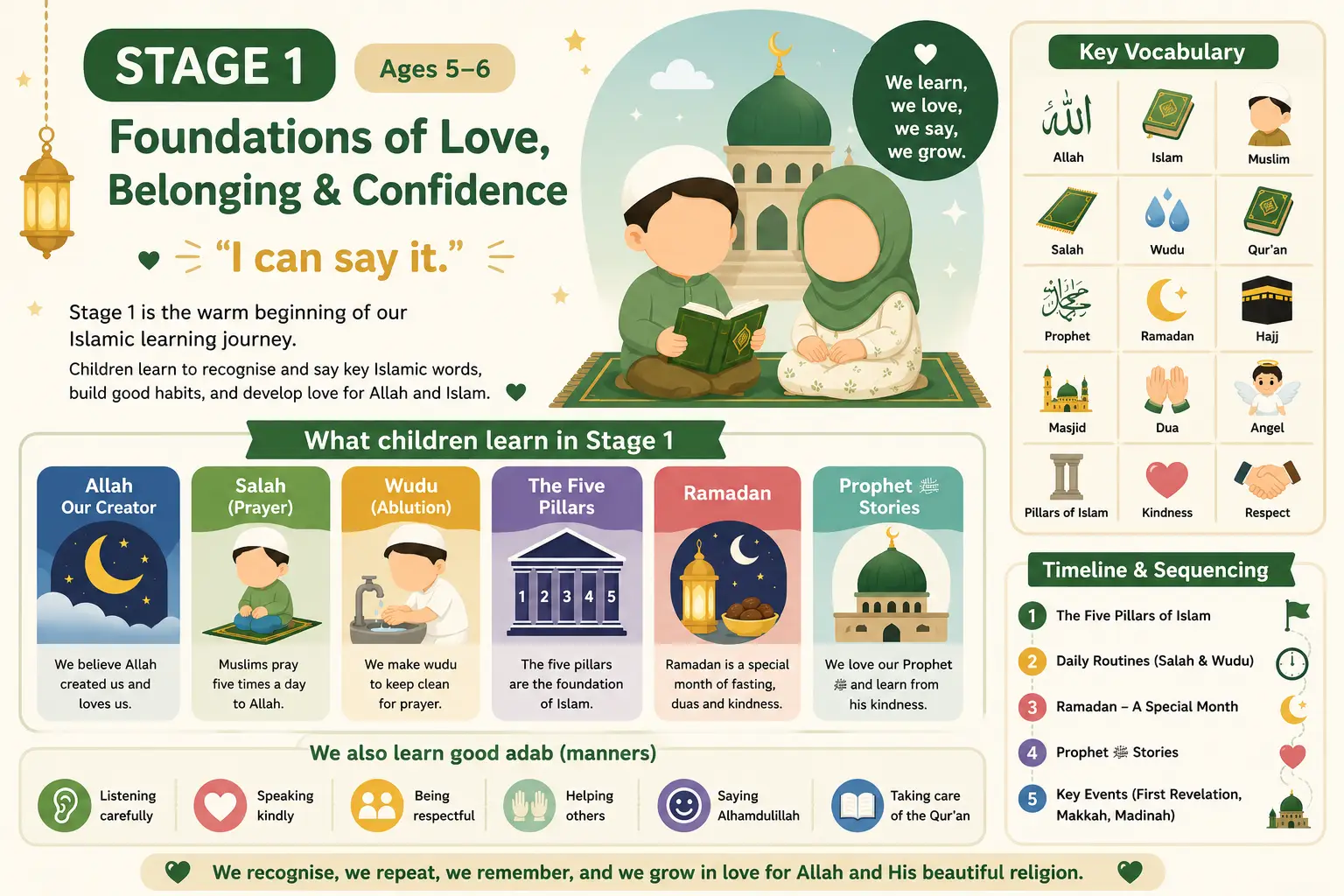
Foundations of Love, Belonging & Confidence
Ages 5–6 | “I can say it.”
Stage 1 provides a warm and nurturing introduction to Islamic learning. The emphasis is on helping children feel safe, confident and proud to be Muslim while developing a positive relationship with Allah, the Qur'an and the Prophet ﷺ.
Children are introduced to key Islamic vocabulary, the Five Pillars, simple beliefs, basic worship practices and foundational stories from the Seerah. Lessons are highly interactive and age-appropriate, using storytelling, discussion and practical activities to build engagement and confidence.
Children develop:
Ages 5–6 | “I can say it.”
Stage 1 provides a warm and nurturing introduction to Islamic learning. The emphasis is on helping children feel safe, confident and proud to be Muslim while developing a positive relationship with Allah, the Qur'an and the Prophet ﷺ.
Children are introduced to key Islamic vocabulary, the Five Pillars, simple beliefs, basic worship practices and foundational stories from the Seerah. Lessons are highly interactive and age-appropriate, using storytelling, discussion and practical activities to build engagement and confidence.
Children develop:
- Love for Islam and Muslim identity
- Confidence in speaking and participation
- Recognition of key Islamic concepts and vocabulary
- Basic understanding of Salah, Wudu, Ramadan and Hajj
- Listening skills and classroom routines
- Positive habits of kindness, honesty and respect
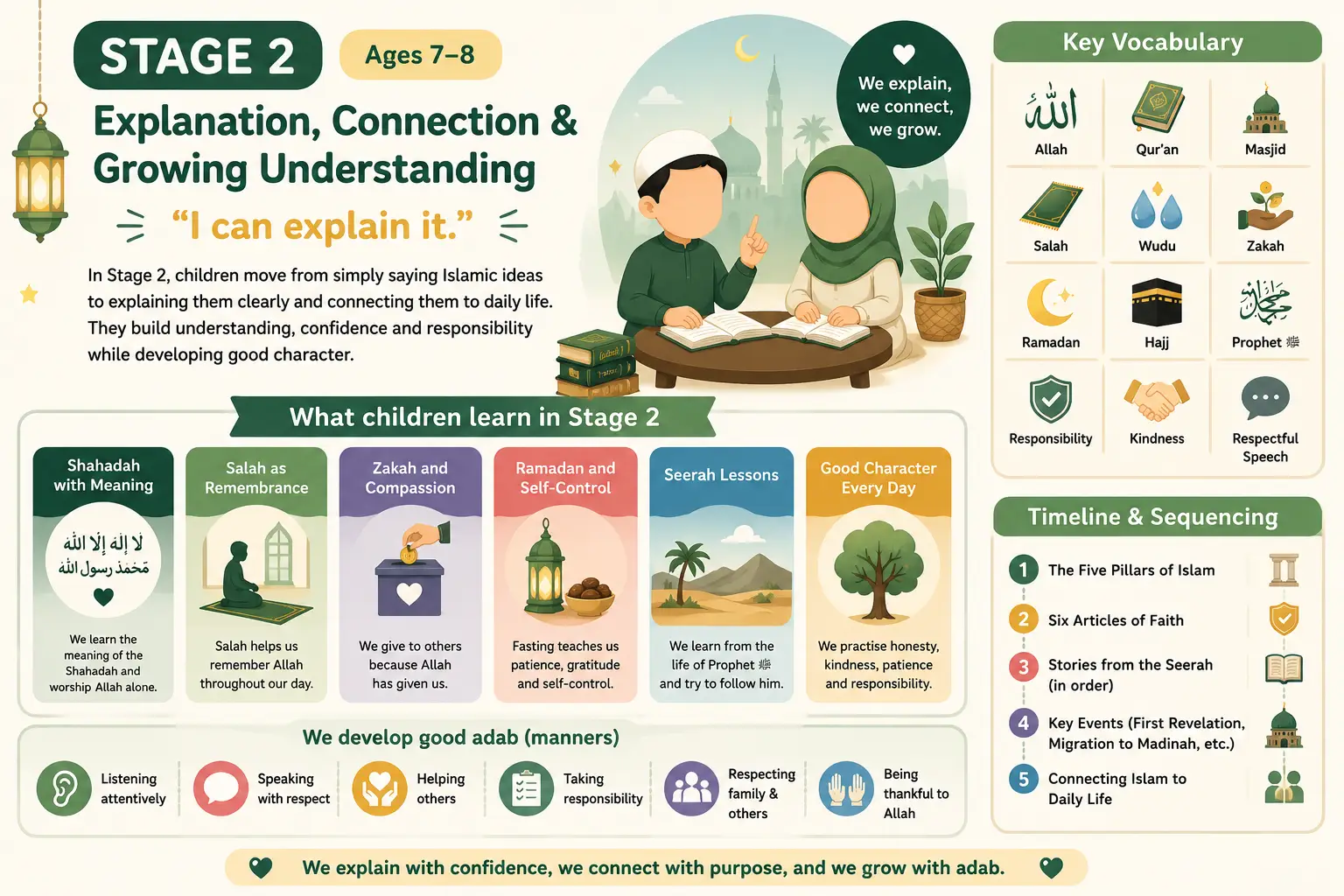
Understanding & Connection
Ages 7–8 | “I can explain it.”
As children mature, they begin moving beyond simple recall towards understanding. Stage 2 focuses on helping pupils explain Islamic ideas clearly and connect them to their daily lives.
Children explore the meaning behind worship, belief and good character. They learn to answer simple "why" questions, explain Islamic concepts using full sentences and recognise how Islam guides everyday choices at home, school and within friendships.
Children develop:
Ages 7–8 | “I can explain it.”
As children mature, they begin moving beyond simple recall towards understanding. Stage 2 focuses on helping pupils explain Islamic ideas clearly and connect them to their daily lives.
Children explore the meaning behind worship, belief and good character. They learn to answer simple "why" questions, explain Islamic concepts using full sentences and recognise how Islam guides everyday choices at home, school and within friendships.
Children develop:
- Clearer understanding of Islamic beliefs and worship
- Ability to explain concepts rather than simply recall them
- Stronger communication and discussion skills
- Greater responsibility and independence
- Respectful interaction with peers and adults
- A growing awareness of how Islam shapes behaviour and decision-making
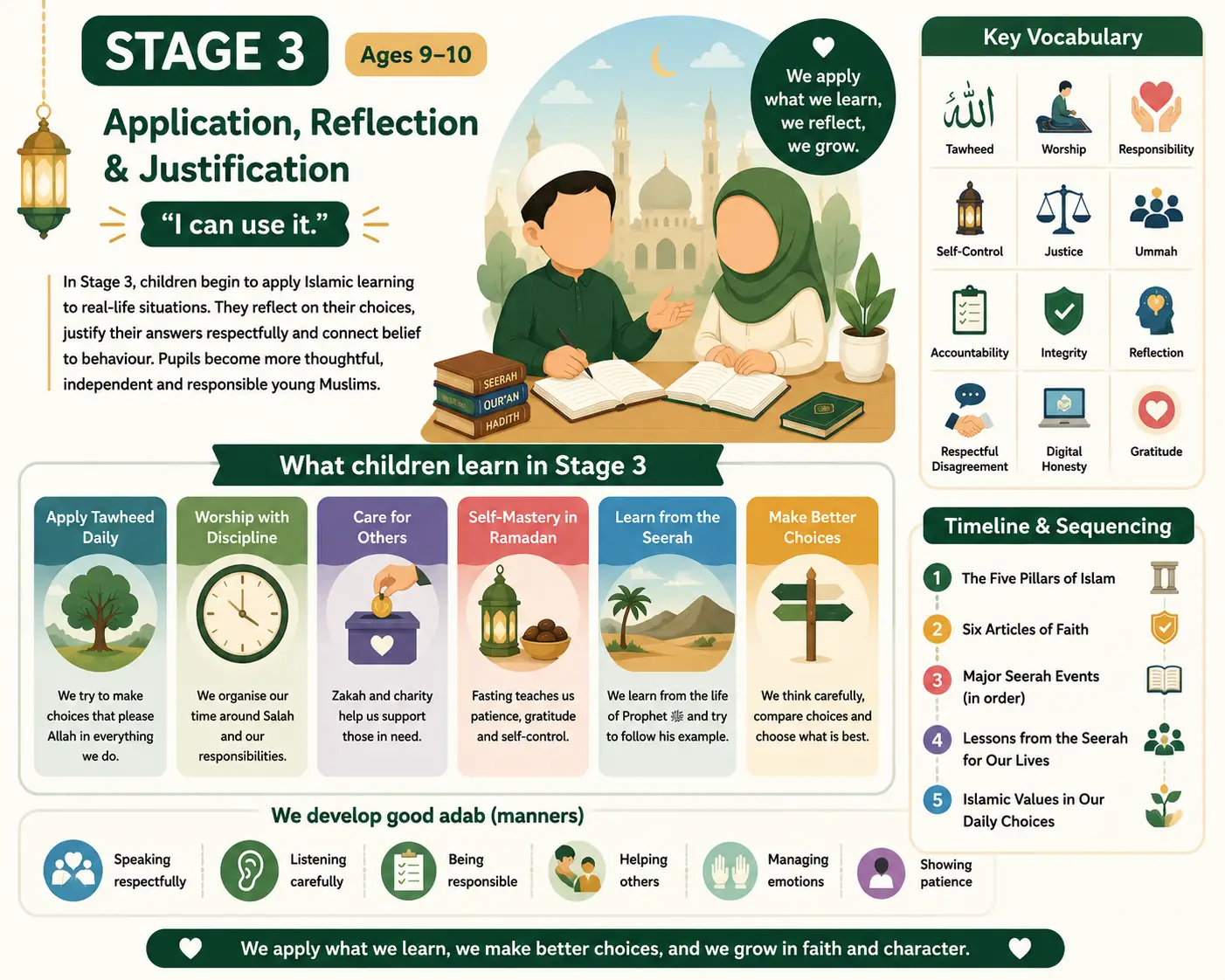
Application & Reflection
Ages 9–10 | “I can use it.”
Stage 3 encourages pupils to apply Islamic learning thoughtfully to real-life situations. Rather than only learning what Islam teaches, children begin exploring how those teachings influence choices, behaviour and personal responsibility.
Lessons increasingly include reflection, discussion and practical scenarios. Pupils learn to justify their answers respectfully, compare different responses and think carefully about how Islamic values can guide them in modern life.
Children develop:
Ages 9–10 | “I can use it.”
Stage 3 encourages pupils to apply Islamic learning thoughtfully to real-life situations. Rather than only learning what Islam teaches, children begin exploring how those teachings influence choices, behaviour and personal responsibility.
Lessons increasingly include reflection, discussion and practical scenarios. Pupils learn to justify their answers respectfully, compare different responses and think carefully about how Islamic values can guide them in modern life.
Children develop:
- Confidence in applying Islamic principles to everyday situations
- Ability to justify choices and opinions respectfully
- Deeper understanding of worship, character and responsibility
- Greater self-awareness and personal reflection
- Skills for navigating friendships, technology and social situations
- Stronger links between belief, character and behaviour
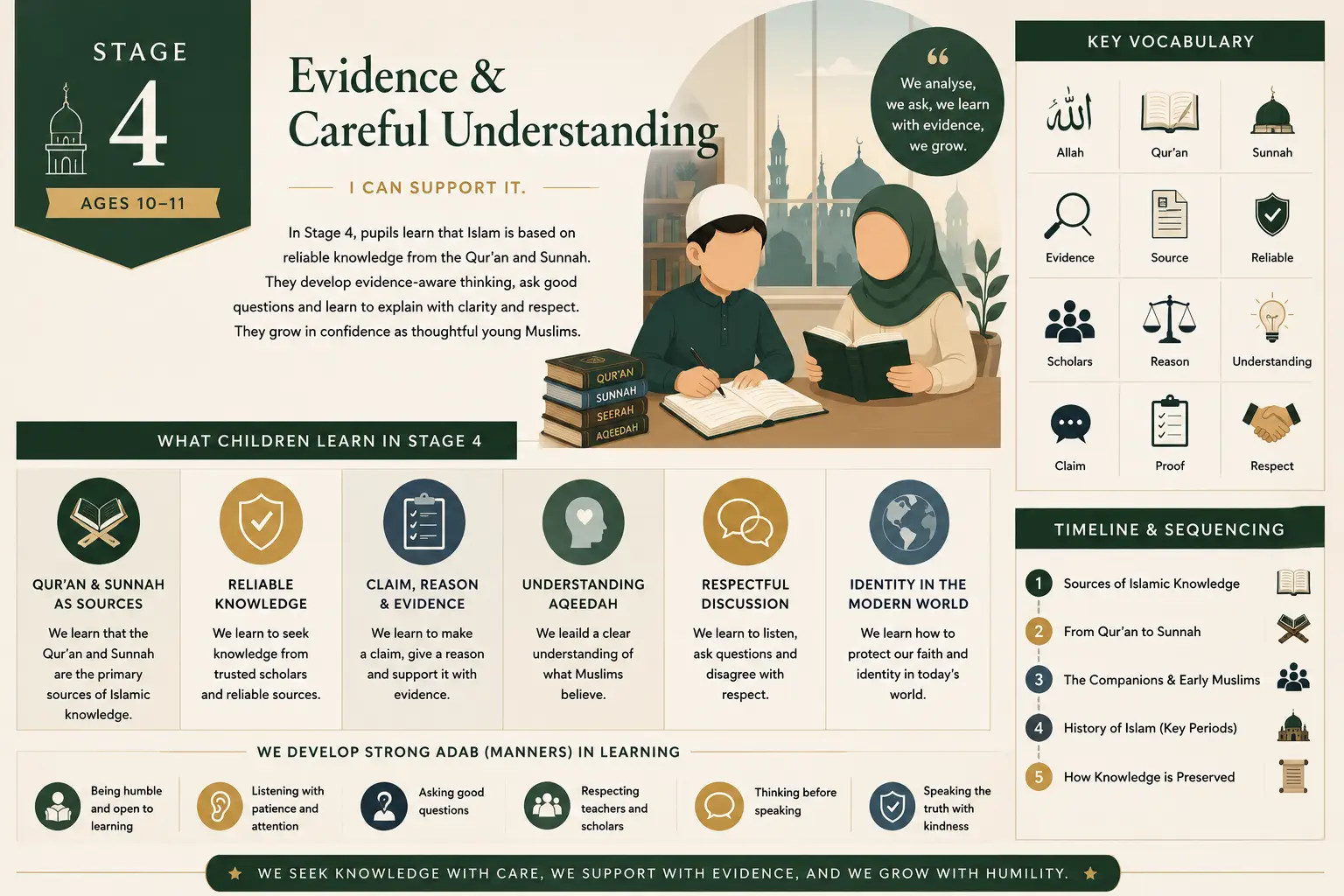
Evidence & Careful Understanding
Ages 10–11 | “I can support it.”
Stage 4 introduces pupils to a more mature understanding of how Islamic knowledge is learned and understood. Children begin exploring Aqeedah in greater depth and learn that Islam is built upon reliable sources such as the Qur'an and Sunnah.
Pupils develop structured thinking, evidence awareness and respectful discussion skills. They learn how to distinguish between reliable knowledge and personal opinion while strengthening their confidence as young Muslims.
Children develop:
Ages 10–11 | “I can support it.”
Stage 4 introduces pupils to a more mature understanding of how Islamic knowledge is learned and understood. Children begin exploring Aqeedah in greater depth and learn that Islam is built upon reliable sources such as the Qur'an and Sunnah.
Pupils develop structured thinking, evidence awareness and respectful discussion skills. They learn how to distinguish between reliable knowledge and personal opinion while strengthening their confidence as young Muslims.
Children develop:
- Understanding of Aqeedah and Muslim belief
- Awareness of the Qur'an and Sunnah as primary sources
- Evidence-based thinking and structured explanation
- Respect for Islamic scholarship and learning
- Confidence in discussing Islamic topics carefully and responsibly
- Greater resilience when facing modern challenges and misinformation
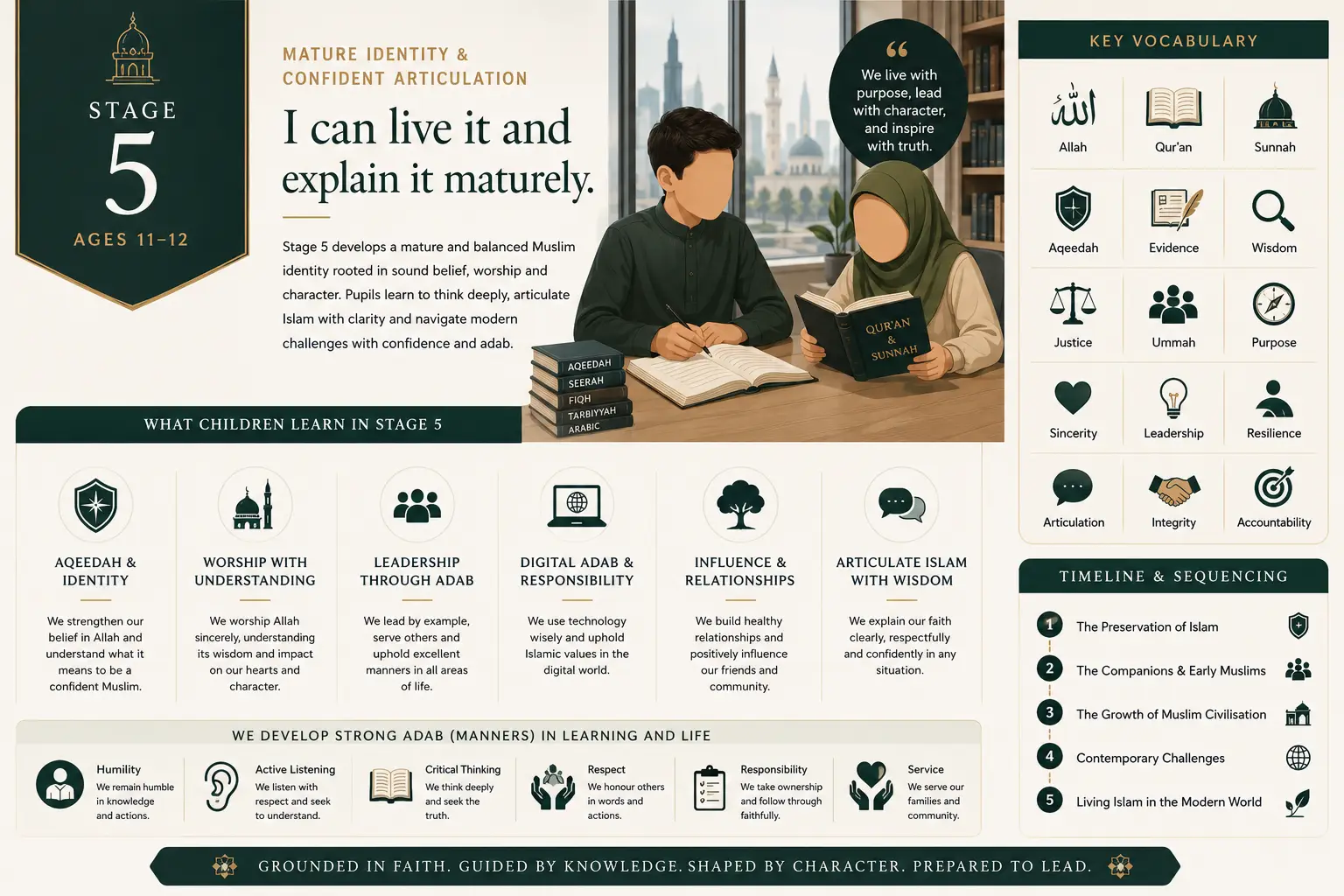
Mature Identity & Confident Articulation
Ages 11–12 | “I can live it and explain it maturely.”
Stage 5 represents the culmination of the Hijrah Academy journey. Pupils move beyond understanding concepts to internalising them as part of their identity, worship, character and daily decision-making.
The curriculum focuses on developing thoughtful, balanced and confident young Muslims who can articulate Islamic principles with maturity, humility and good adab. Pupils explore contemporary challenges while learning to remain grounded in authentic Islamic teachings.
Children develop:
Ages 11–12 | “I can live it and explain it maturely.”
Stage 5 represents the culmination of the Hijrah Academy journey. Pupils move beyond understanding concepts to internalising them as part of their identity, worship, character and daily decision-making.
The curriculum focuses on developing thoughtful, balanced and confident young Muslims who can articulate Islamic principles with maturity, humility and good adab. Pupils explore contemporary challenges while learning to remain grounded in authentic Islamic teachings.
Children develop:
- A mature and confident Muslim identity
- Strong connections between belief, worship and character
- The ability to articulate Islamic concepts thoughtfully and respectfully
- Leadership through service, responsibility and good character
- Emotional maturity, resilience and self-awareness
- Confidence in navigating modern life while remaining firmly connected to Islamic values
FAQs
Our curriculum follows a progressive five-stage journey, developing pupils from foundational knowledge to mature understanding and confident articulation of their faith.
Pupils study Qur’an, Islamic Studies, Aqeedah, Seerah, worship, adab, character development, and Muslim identity.
Yes. Every stage is carefully designed around children's developmental needs, maturity, and understanding.
Yes. Adab, kindness, honesty, gratitude, patience, and responsibility are embedded throughout the curriculum.
Yes. Pupils explore topics such as friendships, technology, online behaviour, responsibility, and Muslim identity in an age-appropriate way.